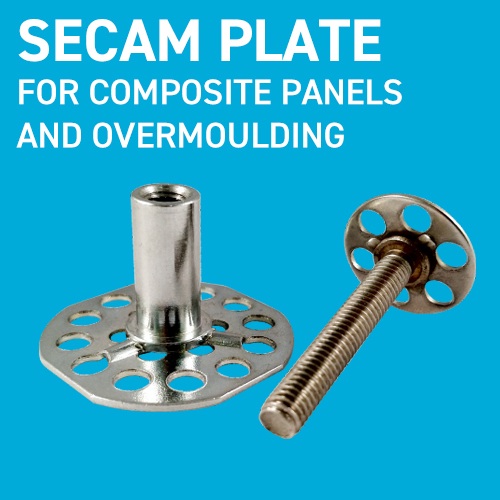

For composite panels and overmolding
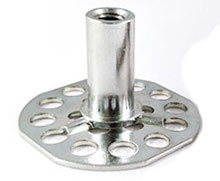
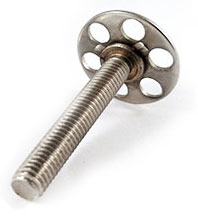
GCP
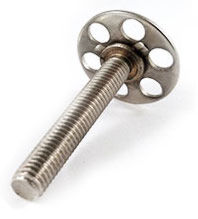
Threaded stud
-
Thread: From M4 to M10 – depending on reference
-
Usable length: From 3.2 to 40 mm – depending on reference
-
Base plate: Depending on reference
- Material: Zinc-plated steel, A4 stainless steel – depending on reference
ICP
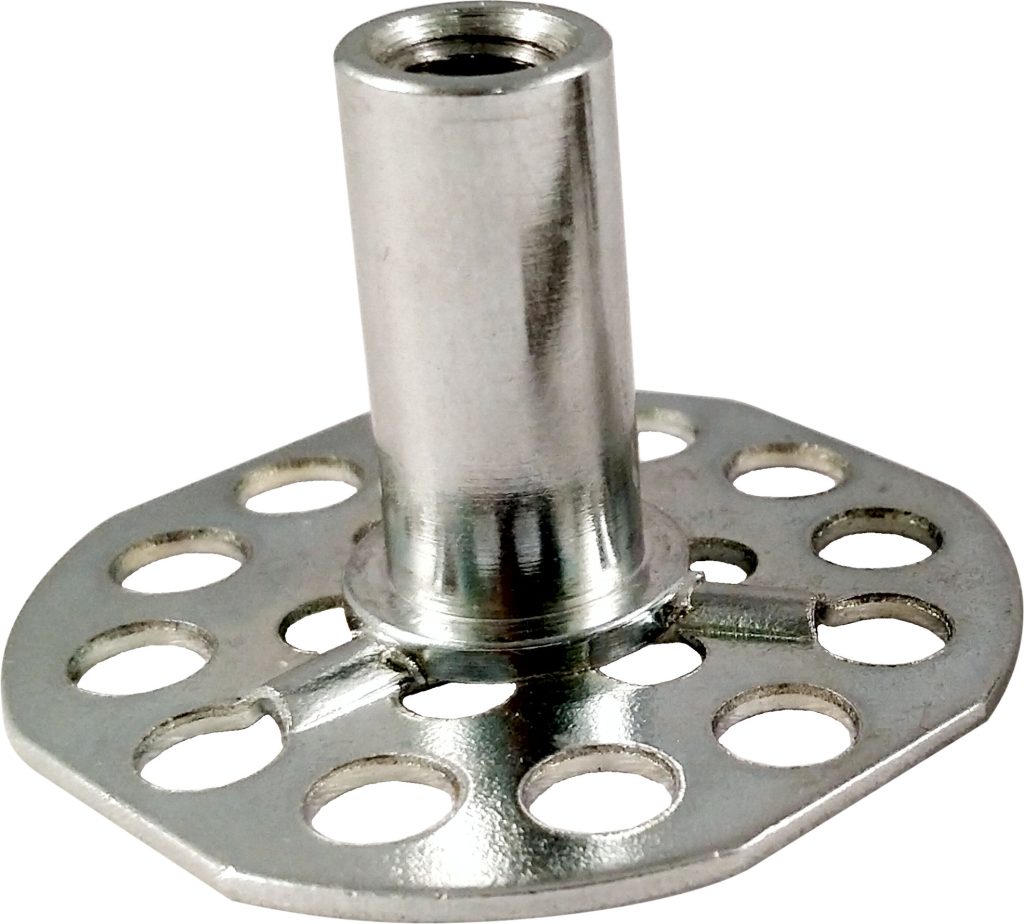
Threaded insert
-
Thread: From M4 to M10 – depending on reference
-
Usable length: From 3.2 to 40 mm – depending on reference
-
Base plate: Depending on reference
- Material: Zinc-plated steel, A4 stainless steel – depending on reference
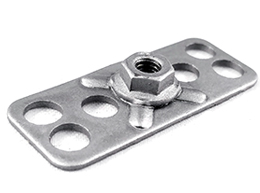
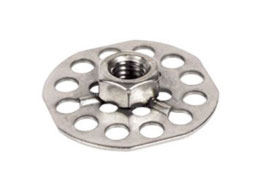
ECP
Flanged nut
-
Thread: From M4 to M10 – depending on reference
-
Usable length: From 3.2 to 40 mm – depending on reference
-
Base plate: Depending on reference
- Material: Zinc-plated steel, A4 stainless steel – depending on reference
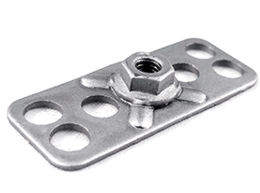
HCP
HEXAGON NUT
-
Thread: From M4 to M10 – depending on reference
-
Usable length: From 3.2 to 40 mm – depending on reference
-
Base plate: Depending on reference
- Material: Zinc-plated steel, A4 stainless steel – depending on reference
Make your choice by clicking on the desired characteristics.
For any specific request, please get in touch via the contact form .
MANUFACTURING' PROGRAMME
Studs
Insert
Flange Nuts
Hexagon Nuts
15x15mm
∅19mm
∅20mm
∅23mm
32x32mm
∅38mm
38x15mm
Reference
CONTACT-US
Do you have a technical or commercial question?
Leave your contact details so we can get back to you.
You can also email us or call us.
S-Plate Composite Fasteners
Reliable and high-performance bonded inserts
Composite materials are now essential in many industrial sectors. To meet fastening requirements on these technical substrates, SECAM Fixing offers a complete range of S-Plate bonded inserts, designed to ensure optimal mechanical performance and simple, fast installation. Whether you work in aeronautics, rail or industrial equipment, our solutions adapt to your constraints.
Why choose S-Plate bonded inserts?
An efficient solution for composites and sandwich panels
Traditional fasteners are often unsuitable for composite materials or sandwich panels. S-Plate inserts provide excellent pull-out and torque resistance without damaging the structure of the material. Thanks to a controlled bonding process, they ensure an even distribution of loads and avoid the weak points that can be created by conventional drilling or tapping.
Easy implementation and standardised range
Our S-Plate range is made up of standardised bonded inserts that are easy to integrate into your production processes. Their geometry is designed for compatibility with a wide variety of industrial adhesives (two-component, epoxy, methacrylate, etc.). Installation can be carried out manually or in semi-automated mode, depending on the throughput and requirements of your workshop.
For projects requiring design assistance or process optimisation, our engineering department can support you from the study phase through to industrialisation.
Our standard range of S-Plate bonded inserts
Below you will find a complete selection of our S-Plate inserts, available in several formats, threads, lengths and materials. Each model can be defined according to your required mechanical performance, available bonding surface and type of composite or sandwich structure.
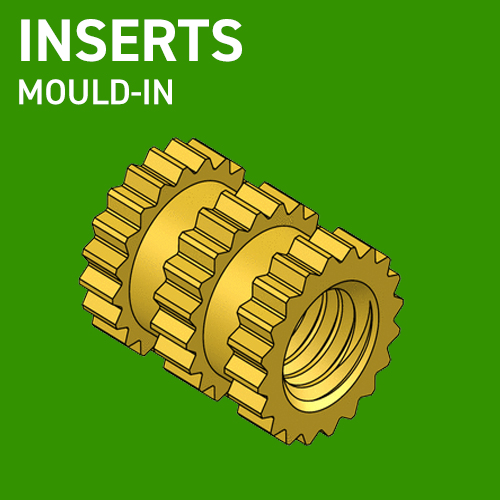
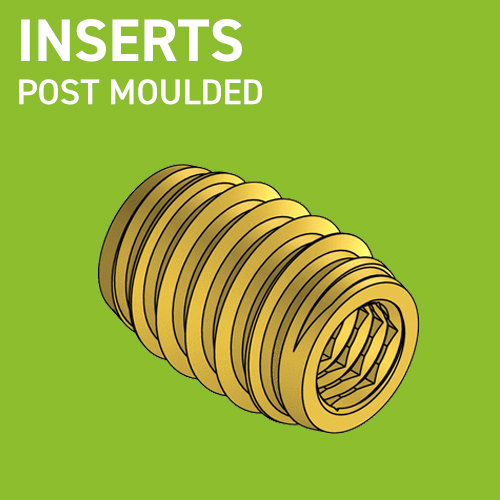
For specific applications, our in-house engineering team can design custom solutions adapted to your technical or environmental constraints. We also offer complementary fasteners such as mould-in inserts and post-moulded inserts for plastics and light alloys.
How to choose your S-Plate insert?
- Thread type: from M3 to M8, or imperial threads on request
- Material: steel, stainless steel or brass, depending on mechanical and chemical requirements
- Insert shape: round, hexagonal or specific design
- Configuration: with or without flange, through-thread or blind thread
Which industries use S-Plate fasteners?
Bonded fasteners are increasingly used in industries where low weight, strength and reliability are critical. Our customers integrate S-Plate inserts in:
- Aeronautics: interior fittings, lightweight lining systems
- Rail: partition panels, on-board equipment
- Renewable energies: fixings on composite structures
- Technical furniture: on-board or modular fittings
S-Plate inserts avoid deep drilling into sandwich structures, while providing a fastening solution that resists vibration and repeated mechanical loads.
A clean, repeatable and durable fastening solution
Bonding reliability with visual indicator (optional)
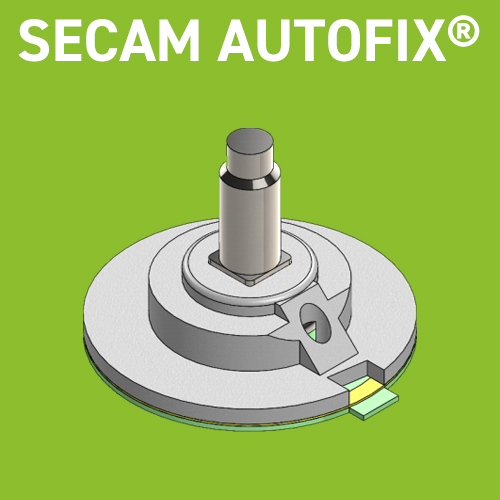
As an option, some of our S-Plate inserts can be combined with a visual fill indicator system (similar to our SECAM Autofix® solution). This makes it possible to check proper adhesive filling during installation and significantly reduces the risk of defects in production.
Compatibility with automated processes
S-Plate bonded fasteners can be integrated into partially or fully automated processes. They are suitable for high-speed assembly lines and can be used with adhesive dispensing robots or controlled-pressure devices. Our range of fasteners for composites and sandwich panels is designed to facilitate industrial integration and repeatable quality.
Comparison with other SECAM solutions
SECAMnida® or S-Plate?
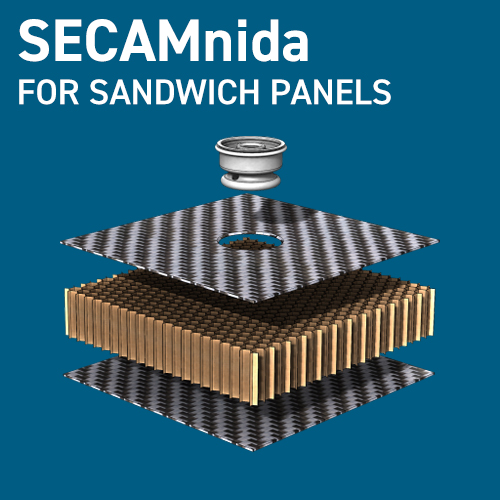
For applications on honeycomb sandwich panels, you may also consider our SECAMnida® solution, which is based on a mechanical crimping principle combined with adhesive injection and an integrated visual indicator.
The S-Plate range stands out through its simplicity of implementation, adaptability to complex surface geometries and reduced overall cost. Each solution has its own strengths depending on the project, which is why it is essential to consult us if you are unsure which fastener is best suited to your application.
How to integrate S-Plate inserts into your project?
The choice of the right insert depends on several criteria: nature of the substrate, mechanical loads, chemical environment, operating temperature, installation method, etc. Our team supports you in this study phase, drawing on recognised industrial expertise and feedback from demanding sectors.
Our engineering office guides you in selecting or designing specific fasteners and can provide samples for technical validation in your workshop.
Need a quotation or technical support?
For any specific request, we invite you to contact us via our contact form. You can also explore all our solutions for composites and sandwich panels and find out more about SECAM Fixing and our industrial expertise.
SECAM Fixing provides reliable, tested products that are adapted to your industrial reality and long-term performance requirements.
Contact-us
Do you have a technical or commercial question?
Leave your contact details so we can get back to you.
You can also email us or call us.
FAQ – S-Plate Composite Fasteners
What is an S-Plate bonded insert?
The S-Plate insert is a fastening solution designed to be bonded onto a composite substrate or sandwich panel. Unlike crimped or screwed inserts, it does not require deep drilling, thereby preserving the integrity of the material. It is ideal for technical environments where low weight, high strength and simplified installation are essential criteria. SECAM’s S-Plate inserts are available as standard products or can be customised to meet specific requirements in terms of load capacity or footprint.
When should I use a bonded insert instead of a crimped insert?
S-Plate bonded inserts are particularly suitable for fragile or multi-layer materials such as composite or sandwich panels. Unlike crimped inserts, they do not apply mechanical constraints to the structure and require no deformation. Installation is therefore gentler and simpler, while maintaining reliable mechanical performance. They are widely used in aeronautics, rail and industrial sectors where weight reduction and precision are just as important as robustness.
Can S-Plate fastening installation be automated?
Yes, S-Plate fasteners can be integrated into automated or semi-automated assembly processes. Their standardised design and optimised geometry make them compatible with robotic handling or automated assembly lines. SECAM assists customers in integrating its solutions into automated production environments and also offers versions with fill indicators for enhanced quality control. To learn more, consult our engineering department.
Which adhesives are compatible with S-Plate inserts?
S-Plate bonded inserts are compatible with a wide range of industrial adhesives: two-component adhesives, epoxies, methacrylates and polyurethanes. The choice of adhesive depends on the substrate material, environmental conditions (humidity, temperature, vibration) and required mechanical performance. SECAM recommends conducting adhesion tests to confirm compatibility. We can provide samples and support customers during the technical validation process of the appropriate bonding solution.
Are there several models available in the S-Plate range?
Yes, the S-Plate range includes many models with different shapes, dimensions and thread types. Options include round or hexagonal inserts, with or without flange, and metric or imperial threads. Each model can be selected based on the desired characteristics (material type, bonding process, available space, mechanical load). For specific needs, our engineering office can develop a custom version based on your technical drawing.
How do I choose the right bonded insert for my application?
Choosing the right insert depends on several factors: panel material, type of loads (tension, shear), environment (temperature, corrosion), adhesive type, production rate, etc. Our technical teams can support you in making the right selection through sample testing or a complete technical study. You may contact us for personalised guidance or explore our other composite fastening solutions.
What are the alternatives to S-Plate within SECAM?
In addition to S-Plate inserts, SECAM offers other fastening solutions for composite materials, such as:
- SECAM Autofix® – Bonded insert with fill indicator
- SECAMnida® – Crimped insert with adhesive injection
Where can I request a quotation or technical support?
You can contact us directly through our form to obtain a personalised quotation or technical assistance. Our team responds quickly to analyse feasibility, send samples or guide you to the most suitable solution. You may also consult our engineering department for custom development.